

Marc Lindberg drives through Worcester every weekday, maneuvering a large truck full of books, DVDs and magazines through the main streets and congested residential areas.
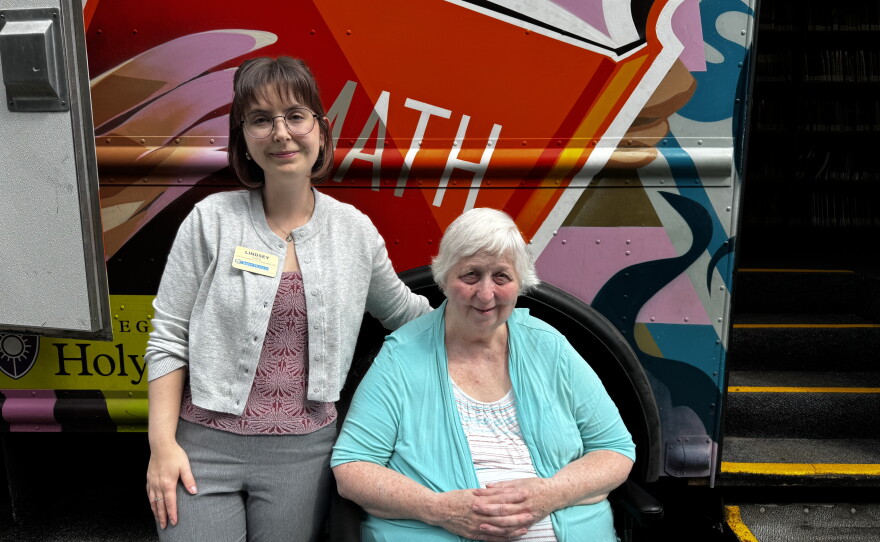
He makes several stops a day with the Worcester Public Library’s bookmobile, sometimes operating a wheelchair lift for disabled patrons to step into the reading space. The lift is essential for patrons at the Saint Francis Rehabilitation and Nursing Center, where Lindberg is making his first stop.
“We don't see a great number of people [at this stop], but 75-80% of them are in wheelchairs that require the lift,” Lindberg said.
Lindberg has been working at the Worcester Public Library’s bookmobile for 14 years. He says the summers can be a bit quieter. But as the school year begins, the bookmobile stops will ramp up as well.
While mobile libraries were once a more visible part of the state’s effort to bring reading materials directly to residents, they are gaining traction today as libraries seek new and less costly ways to reach people.
Mobile libraries, or bookmobiles, have been around since the 1900s, first as a way to get books to rural areas. But today, they have expanded to serve all types of communities.
Worcester has two mobile libraries. The larger one — affectionately named Libby — is where Mary Iram is looking to find her next read after finishing a book about Elton John.
“It's something to do [and] give other people a chance to see what it really looks like, you know, they can't get out very much,’’ Iram said, who has been a regular patron at the bookmobile for several years. “Some are in bed and they can't leave the bed.”
Worcester Public Library uses part of its $10 million budget through the municipality and a payment from College of the Holy Cross to operate its two bookmobiles.
Executive Director of the Worcester Public Library, Jason Homer, says the bookmobile also serves as an important resource for children.
“We try to be out in the neighborhoods and be out in the communities, especially in school, when we have dedicated time with them, safe time with them, and time where we can make sure that they're walking away with one to two books every single week,” Homer said.
Building community, one stop at a time
Bookmobiles have made a comeback in recent years. In 2019, there were just five in Massachusetts. Now there are 16, according to the Massachusetts Board of Library Commissioners, with new ones popping up in Newton and Watertown.
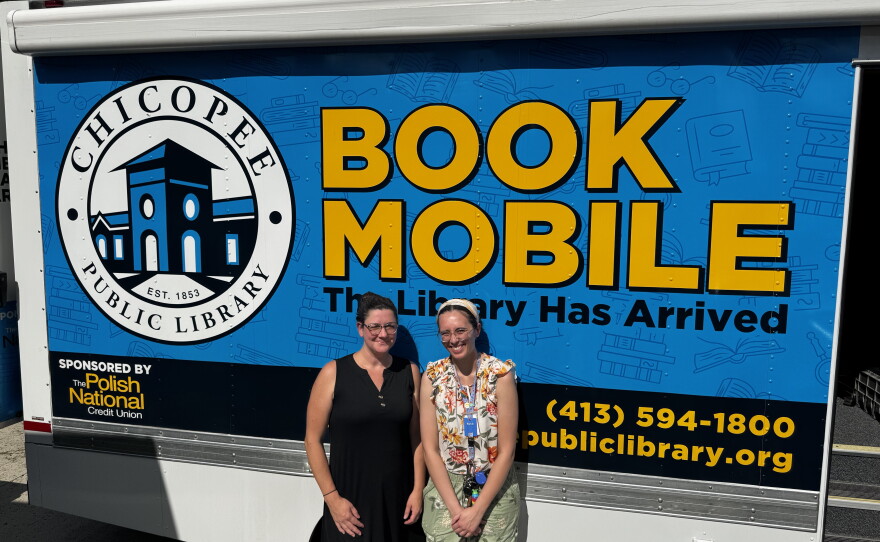
It was an unexpected surprise for Chicopee resident Sarah Phaneuf to stumble upon the city’s bookmobile — which looks like a standard U-Haul with “Chicopee Public Library’s Bookmobile” emblazoned on the front in yellow with the library’s logo on the side.
Phaneuf was on her way to the pool at the Doverbrook Condominium where she lives and saw the truck parked nearby.
“I brought a book, but now that I'm here, I'll look to see what other books there are,” Phaneuf said, smiling.
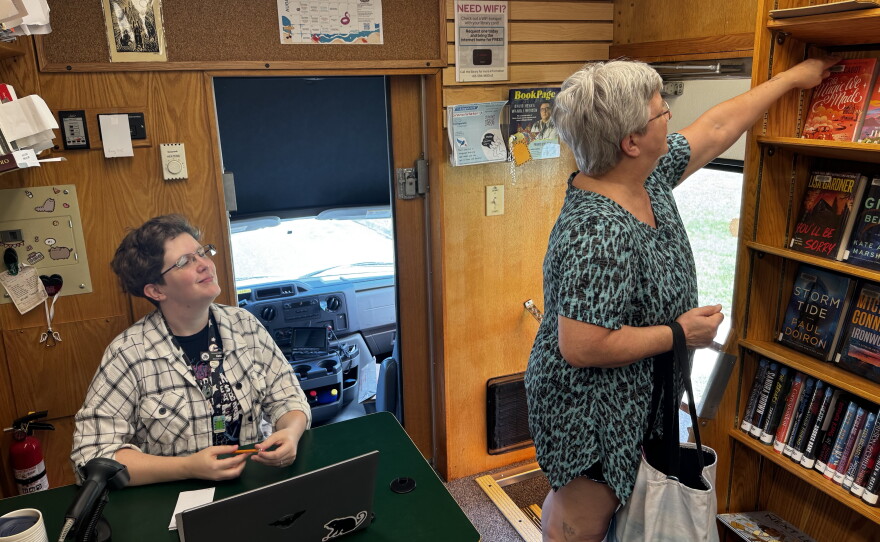
Bookmobiles work like a library branch. Patrons can sign up for a library card on it if they don’t have one or renew their library card. They can request to have books sent to the bookmobile and pick them up at whatever stop is most convenient for them. The schedule is usually posted on the library’s website.
There are 15 public libraries across the state that currently have bookmobiles, according to the Massachusetts Board of Library Commissioners. Seven are in Gateway Cities, like Quincy and Worcester, which are defined by the state as midsized, urban communities where median household incomes are less than the state average.

Chicopee, with a population of about 55,000 and a median income of a little over half the size of Massachusetts, launched its bookmobile in 2014, paid for by a donation from the Polish National Credit Union.
The Chicopee Public Library relies on its bookmobile to interact with residents like Phanuef who maybe wouldn’t have gone into the library building itself, but could be reintroduced to new titles through this resource.
Kate Ouimette was one of the librarians on duty during the recent bookmobile stop outside the Doverbrook Condominium.
“We just want everybody here. And if this is how we can get you to access the library – great! This is the library on wheels,’’ she said. “We can do almost anything that the main library can do, and we're happy to have folks come in. That's all we want.”
The library’s budget, which is just under $2 million, factors in the cost of books for the bookmobile. The city of Chicopee provides general maintenance and gas for the truck, as it does with all city vehicles.
Ouimette said the bookmobile makes a couple stops a month — three times a week at two different locations in the city.
The second stop after Doverbrook was Cabot Manor youth center. The children’s librarian, Beth Oliveira, says she loves the experience.
“I feel cool. I feel like I'm on a parade float because people honk at us. People wave at us. They love to see us coming,” Oliveira said. “I've been doing this for a couple years now, and it's always so much fun because people are always like, ‘The bookmobile is here.’ … And for the first time, if kids come on and they're like, ‘I didn't know there were books on here!’ And I'm like, ‘Yeah, it's a bookmobile!’”
Oliveira also mentioned how important it is for bookmobile librarians to interact with regulars. These small interactions with residents – being on first name basis with a librarian, handpicked suggestions – helps build community trust one stop at a time, she said.
“It's also not just, ‘Oh, the bookmobile is here.’ It's ‘Oh, the librarian Beth is here,’’’ she said. “People know us by name and we know them by name.”

Bookmobile renaissance
In Quincy, librarians recently cut the ribbon on a new $10,000 book bike — a three-wheeled cargo bike wrapped in neon-colored cranes, filled with dozens of books for all ages.
Sara Slymon, executive director of the Thomas Crane Public Library, said the book bike was funded entirely by the Friends of the Thomas Crane Public Library.
“The idea of riding the book bike up and down, playing music, kind of like an ice cream truck, to get people to come take books from us while they were at the beach with their families was super appealing,” Slymon said.
She says that mobile libraries are also generally less expensive to run than a traditional library.
“They're pretty affordable, honestly. They're like $80,000, which is a lot of money, but to build even the smallest new branch would be $10 million,’’ Slymon said. “So it's a good way to stretch the taxpayer dollar to get out to everybody without spending, you know, millions of dollars.”
Slymon said they had a bookmobile truck decades ago but it was shut down due to the recession. Since the pandemic, however, Slymon says libraries across the state have also seen the appeal of extending their resources to meet residents where they are.
It's just blowing up everywhere,” she said. “They're all over the place.”
And as some residents juggle raising a family, multiple jobs or transportation issues, mobile libraries are paramount to address accessibility needs.
“This seemed like the right idea for a sort of affordable and attainable goal to make library services more accessible equally to everyone.”
The seeds of this story began with a conversation held at a listening session in Chicopee, part of a GBH News initiative to visit all 26 Gateway Cities this year. NEPM News joined in for sessions in the five western Massachusetts gateway cities.
Do you have something about your community that you want to share? Email us at equityandjustice@wgbh.org.


