






When CAI first looked into the economics of Cape Cod 20 years ago with an award-winning series of reports called “The Two Cape Cods: Hidden Poverty on the Cape and Islands,” a number of important topics were covered.
The series, produced by Sean Corcoran, looked at such things as homelessness; the struggles of many Wampanoag tribal members to afford to live in their ancestral homeland; the affordable housing crisis; foster care for children of impoverished families and many others.
As I reviewed the stories from 2006, one that struck me focused on a man from Truro who was far from poor, but who had suffered some health problems that resulted in him losing his driver’s license. This meant that he had to piece together a network of rides from friends, bus transportation and even hitchhiking to get where he needed to go.
“It isn’t a good way to go shopping, for instance. Because there isn’t the kind of frequency that makes it easy,” Bill Worthington said at the time. ACape Cod Community College student quoted in the story said much the same thing; more frequency of bus service would make life a lot easier for students.
For Worthington and others at that time, public transportation was not robust enough to be relied on. So, I began to think about public transportation on Cape Cod and how it has changed over the years.
I have been a news reporter and editor on the Cape since the 1980s and I have seen a lot of changes to the public transportation system. I remember when there was very limited bus service to the outer reaches of Cape Cod from Hyannis, then as now considered the transit hub of the region.
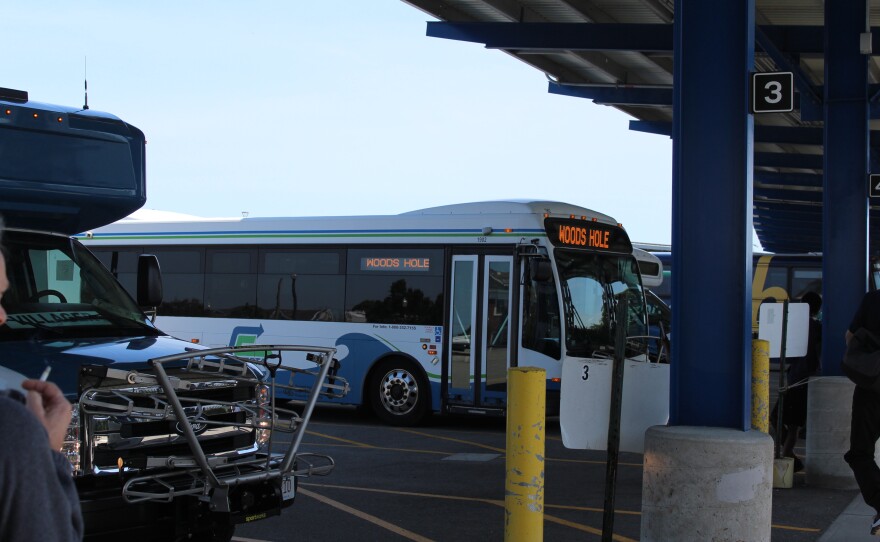
The Hyannis Transportation Center was built in 2002 and it consolidated the region’s rail and bus service to downtown Hyannis. Today, shuttles link the bus and train hub to the nearby Cape Cod Gateway Airport. The idea is that visitors to the Cape can fly into Hyannis and seamlessly link up with ground transportation. And that’s a good thing for people with the money to fly to and from the Cape. But what about the locals who want or need to use public transit?What happens to those who cannot drive due to any number of factors? In many cases they ride the bus.
WHO’S ON THE BUS?
So, one very hot July day, I got on a bus in Hyannis, and, while riding a clean, air-conditioned bus with about eight passengers aboard, I got to know some of the people who rely on public transportation to get them to everyday events like shopping andmedical appointments.
As I waited to board at the transportation center in Hyannis I noticed a woman pulling a cart that held two large bags. She obviously was a regular, chatting with the bus driver who lowered a ramp so that she could wheel her cart aboard the bus. At first the woman declined to talk to me, but once we were on the bus and in motion, she pointed to a young woman and indicated she would be a good interview.
It turned out the young woman named Gulnar from Kazakhstan in Central Asia, was on the Cape to work for the summer, one of the estimated 5,000 workers who arrive on J-1 visas which allow them to work temporarily.
“It’s very convenient and I use it almost every day,” she said.
Wd talk about how many summer workers don’t use public transportation. They prefer bicycles and electric scooters which allow them to go to and from jobs without having to wait to make bus connections. Many of them work late shifts and they are going home late at night after bus service has ended. Many also have more than one job so that they have to pivot quickly from one to another. But Gulnar chose the bus. She said she was well aware of the many reported accidents and injuries each summer involving other J-1 students.
She was also impressed by the fact that CCRTA bus transportation is free.
“I was very shocked when I got entered the bus the first time and people said it’s free. It’s so good for us. When you a limited budget it’s very cool,” she said. Gulnar was goingto the Cape Cod Mall, where she wanted to apply for a second summer job.
AVAILABILITY IS IMPORTANT
As the trip continued, the woman who at first declined to be interviewed gestured to me. While she would not give me her name, she agreed to talk about the CCRTA system.
“I am a local. I’ve been taking the bus since 2015,” she said, noting that the bus is generally on time. But, she pointed out that frequency of service limits availability. “There’s only one bus that goes from Orleans to Hyannis and Hyannis to Orleans. And if you miss that bus you have to wait another hour.”
She said she cannot afford a car so she relies on public transportation, and she said it is her experience that; “since 2015 it has improved in being on time.” She also sees a greater variety of service available. Still, she said when the bus is on Route 28 on a busy summer day, it’s at the mercy of heavy traffic.
Also on the bus was Sara Simmons who grew up on the Cape. She was taking the bus while she sorted out what to do with her car that needs a new transmission.
“That’s why I take the bus. But it works,” she said. During our trip Simmons pointed out the schools she attended and chatted with other passengers.
Another local, Georgina Cormier, said she uses the bus on a regular basis simply to get around Hyannis.
“It’s been pretty reliable when I’ve taken it,” she said, “usually from Star Market on West Main Street to North Street.”
MAKING IMPROVEMENTS
John Kennedy, administrator of the CCRTA, addressed some of the issues the bus riders spoke about.
“The most important thing for people to know about our fixed route service is that it’s free. It used to be a paid services. We have fixed route service to all 15 towns and every singe bus, every single trip is free. That is a major improvement to service,” Kennedy said.
Kennedy said the CCRTA recognizes that public transportation is essential to people’s lives.
“We consider transportation part of the workforce infrastructure. If you can’t get to work, what good is it,” he said. “The folks that generally take our service need us. There aren’t any other options. Uber and Lyft are far too expensive. Asking for rides is not a long-term kind of system. We’re trying to build mobility in our transportation network around real people and real needs, not just around convenient schedules for us.”
In addition to theCCRTA’sfixed-route service, it also offers the Smart Dart, which its website describes as an, “app-based, on-demand ride hail service” for $3 a ride. There are also programs to take people to medical appointments in Boston, and Kennedy said he is working on a program to provide transportation to the Veterans Administration hospital in Providence for Cape vets.
THEN AND NOW
Twenty years ago, when the “Two Cape Cods” series looked at public transportation, apps did not exist and public transit offerings were far less robust that they are today. So, there have been improvements. But it’s clear that public transportation remains only a small part of the lives of most Cape Codders. The CCRTA promotes its services through advertising, and it updates its rolling stock frequently.
As the Cape grows in population, particularly year-round population, it could be that more people will look to public transportation. But, for now, perhaps due to the Cape’s still mostly rural and suburban character and the spread-out nature of its town and village centers, public transportation remains an underutilized an d under-appreciated asset.
