


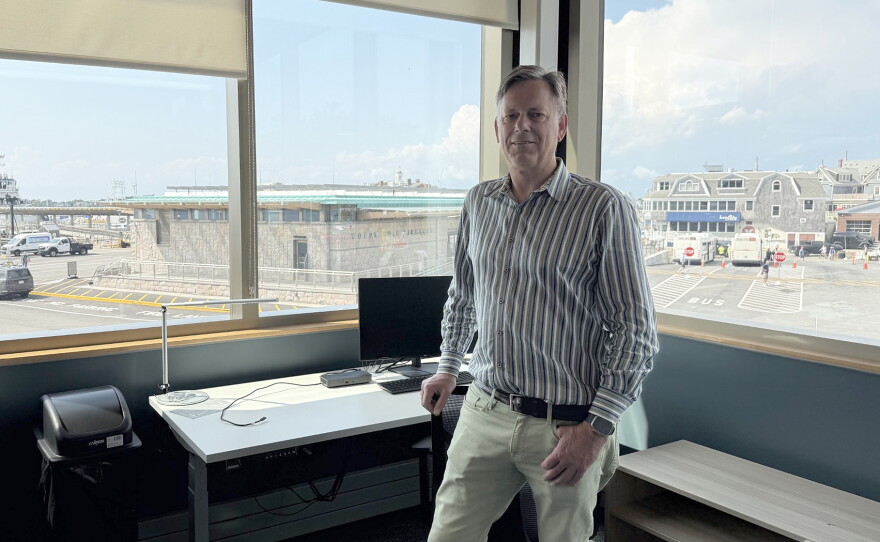
Two years and $39 million in the making, The Steamship Authority’s new terminal buildings opened at the end of June and the start of the busy season for its service between Woods Hole and Martha’s Vineyard. The buildings – one public and one for employees – were part of phase two of the terminal makeover. Phase three, which involves solar panels, bike parking and redesigning traffic patterns, is scheduled to get underway this fall.
The new ticket office is in a large, open space with benches, high ceilings, big widows and glass doors to maximize views and natural light.
"We had a point of having lots of glass," said General Manager Alex Kryska, "so there's a lot of light coming in. You can see the boats coming in. There's a lot of power stations because everybody wants to plug their phone in."
Kryska took charge of The Steamship Authority in January, during the final push to get the project open before the summer rush.
Showing off the new buildings, he pointed out the ticket counter has five service windows, with three typically open for business.
"Even in this day and age of electronic tickets, we get a lot of people who come up who don't have a ticket and want to buy a ticket or have questions, to find out about when the next boat is or whatnot," Kryska explained.
Restrooms round out the other public areas of the building, equipped with low-flow fixtures to reduce water use. Kryska noted, with the aquarium closed for renovations, they are currently the only public restrooms in Woods Hole.
"One of the aspects of the building that we wanted to retain from the old building was to have a big public bathroom available," he said.
The lofty ceilings in the public areas add to the sense of openness but have a practical origin. They’re a byproduct of the need to raise the adjacent mechanical, electrical and telecommunications rooms above the 17-foot flood-proofing requirement.
Flood resiliency is also behind the foot-thick concrete walls, covered on the outside with a veneer of granite. Kryska says the granite is locally sourced, but he acknowledges the look is not the iconic cedar shingles many locals would have preferred.
"There’s too much manual labor involved in maintaining those," he said. "This is much more maintenance-free. And it will withstand, kind of, the elements."
The new facilities are designed for net zero energy use. Heating and cooling are powered by 29 geothermal heat pump wells. The lights are LED. Soon, Kryska said, they’ll be powered by on-site solar which is planned for the third and final phase of the project.
"The first phase was redoing the waterfront, redoing the bulkheads, raising the piers and the docks – making those sustainable towards sea level rise," he said. "And the second phase was the construction of these two buildings ... that was $39 million for the two buildings and all the design work and all the contingencies and all the geothermal work, whatnot. And then the third phase will be landscaping, repaving everything, putting in all the solar and whatnot."
He said the third phase will begin this fall. The old temporary ticket building will come down, making way for a solar canopy over a parking area for around 200 bikes. Another solar canopy will go up over the employee parking lot, in addition to rooftop solar. Kryska said the third phase will also focus on improving traffic flow.
In 2025, the Woods Hole terminal served more than 2.4 million passengers and handled 550,000 vehicle transports.
"A big aspect of the next phase is kind of figure out the whole traffic pattern – how we stage trucks and cars, where we place them, how we run them through the ticket booth," he said. "Right now, we only have one fully active ticket booth. We use a backup in the back there when the lines get long. But having two next to each other is a goal for the next phase.”
However, he said the long-term traffic solution may be an additional terminal off-Cape.
"Another thing we're looking at is expanding, possibly into New Bedford, and seeing if we can take service up to New Bedford, which would ease some of the burden on the village here," he said. "And the burden on the bridges too."
Kryska said it would take five to ten years to get an additional terminal up and running. But, he noted, traffic problems are bound to get worse once construction on the Cape bridges is underway.
"As much as they want to say there's not going to be any traffic, and hopefully there's not going to be a lot of traffic due to bridge construction, there's going to be some," he said. "And just having an alternative for people coming from New York, Pennsylvania, somewhere in the South, they can just jump on a boat in New Bedford. It’s easier than having to come across the bridge and come all the way down here."
New passenger ferries are also on the horizon.
“Some of our other passenger boats are getting, you know, they're over 50 years old. So, we're looking to get those replaced," Kryska said. "And we have to do that to meet the governor's net zero goals.”
Kryska said The Steamship Authority is looking into purchasing hybrid-powered boats, as all-electric boats may not be a viable option.
"We just don't have enough power here in Woods Hole or on the Vineyard to charge them constantly," he said. "The number of trips we take, you’re constantly charging them. That's a lot of electricity you would need."
But some version of an electric ferry isn't out of the question, likely a hybrid. "So, it'd be all electric with, like, a diesel generator to keep the batteries charged. And then you’d plug it in overnight, just so you'd get shoreside energy as well."
Kryska described replacing the oldest passenger ferries in the fleet as a short-term goal. But, he said, it can take six to seven years to design and build that type of ship.


