


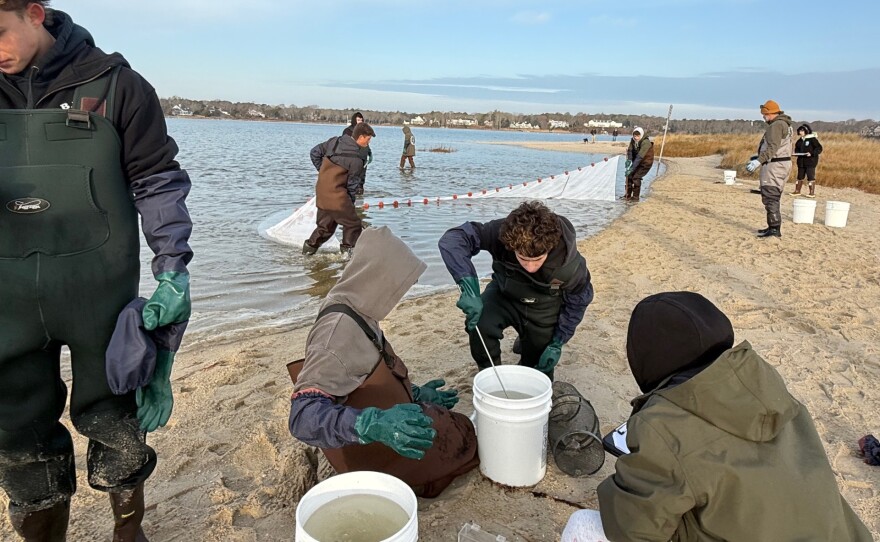

"So, what I have here is one of two bait traps that we have a little bit further down the grass line. And we’re gonna check it," Barnstable High School junior Jack Bunnell explained.
Jack and senior Henry Richardson proceeded to inventory the contents of the bait trap, filled with tiny mummichogs, shrimp and green crabs.

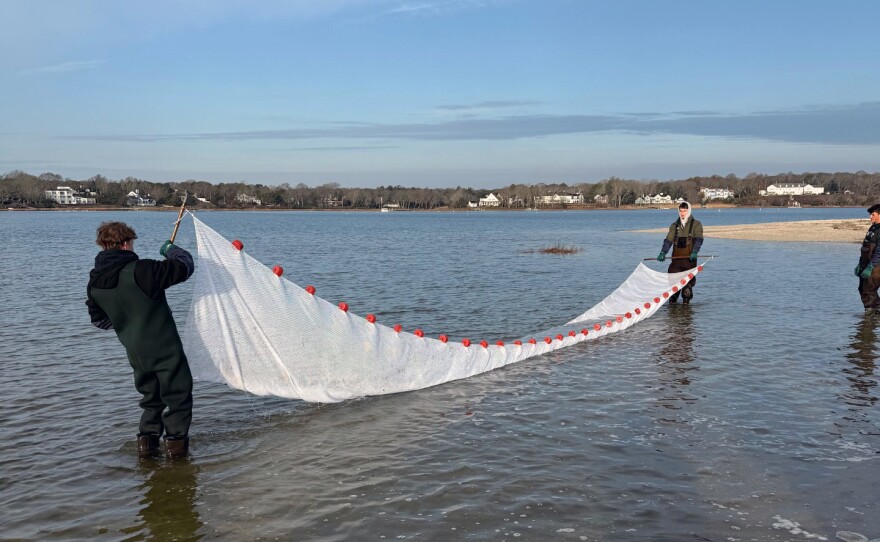
Jack and Henry are part of a team of students spread out across the back side of Dowses Beach, along Barnstable's East Bay. They're all upperclassmen in Barnstable High School's Environmental Science and Technology career pathway. They’re using minnow traps and a long net to survey life in the estuary, as Henry explains:
"So, we’re here today doing a seine net survey," he said. "We’re sampling the species populations in this area, looking at local species – their numbers, their abundance. And then we’re comparing that to water quality data, to see trends in population over time and in comparison to water quality factors."
This stretch of beach, just a short bus ride from school, is an outdoor classroom that these students have come to know well.
Barnstable High School Principal Jason Conetta says his school is utilizing what makes this place unique.
"The work that we do is so conducive to Cape Cod," Conetta said. "So, if you look at a lot of the schools in the Commonwealth, they don't have this opportunity. One, because they don't have the infrastructure. But, two, they just don't have the land. They don't have the opportunities where we have beaches and waters and lakes, and we have so much to offer."

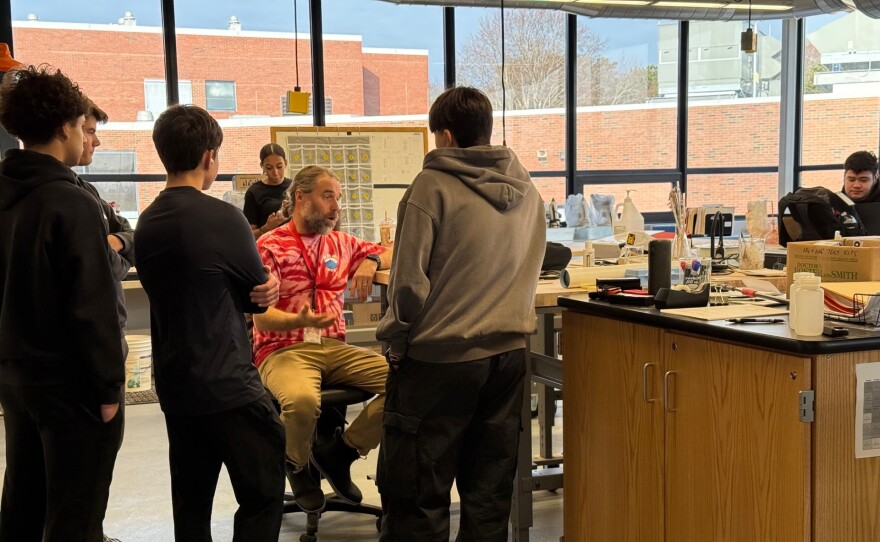
The infrastructure at the school’s marine environmental lab includes a series of 280-gallon fresh and saltwater tanks with fish that the students study and care for. Just outside the lab is a greenhouse, currently filled with hydroponically-grown tomato and basil plants.
But equally important to the success of the program are the partnerships it enjoys with the wider community. Graduation requirements include a community-focused internship and a capstone project, as Henry explains.
"This program runs from freshman year to senior year," he said. "So as you advance, you start doing more advanced coursework. And then, with senior year, it culminates with a senior internship. And then we also come back and do projects like this with Mr. Smith throughout the year. We also work on a capstone project, just exploring some environmental issue that’s affecting Cape Cod."
Mike Smith is one of three teachers in the environmental science and technology pathway. He says community partnerships are an integral part of the program. Smith named a few examples:
"Barnstable Clean Water Coalition’s been a great partner of ours, Barnstable Land Trust – we’ve been doing service projects with them – Sandy Neck, Town of Barnstable Marine and Environmental Affairs."

Senior Colin Gleason interns at Sandy Neck Beach Park.
"We’re doing, like, patrols. So driving up and down the beach looking for maybe animals in distress or just anything out of normal," he explained.
Sandy Neck, which is owned by the town, is currently undergoing construction as part of a long-term coastal resiliency project. And Colin says that’s given the interns a new responsibility.
"There’s these spade-foot toads that live in the ground and pretty much it’s, like, acknowledged that their ecosystem’s going to be disrupted and they might, you know, lose their life," he said. "So we’re trying to do everything we can to prevent that from happening. So one of the things is we’re putting up fencing so toads can’t reach into the places where big machines are and where they’re tearing up ground."
Not every student who joins a career pathway as a freshman has the same ambitions come senior year. Smith says internships can help cater the program to students’ evolving interests.
"We’ve got students that have left here and gone on to become environmental engineers. We’ve got students that have left here and they’re oyster farmers," he said. "We’re trying to point them in the right direction."

Among the current senior class, Henry, who we met tallying minnows, plans to go to law school. Hailey Lee interns at Hyannis Fire Station, and she hopes they’ll hire her once she’s finished school.
"My plans for next year? I’m gonna go to 4Cs to do my EMT and Paramedic certifications," she said. "So then, after that, I’m going to go to West Barnstable, hopefully, to get my Fire I & II certification. So then, I’d like to work at Hyannis again."
Junior Kiera Birch says she was drawn to the program because her mother and grandfather are both oyster farmers. But becoming a third-generation oyster farmer isn’t among her immediate plans.
"I love working with water and stuff, said Kiera. "I am going into the United States Air Force, so this is kind of like, I don’t know, just something fun."
Barnstable High School offers an array of career pathways, but the Environmental Science and Technology program is unique in that it’s a state-approved Chapter 74 Career Technical Education program. Teacher Mike Smith says part of the job is helping students find their passion.

"We’re a vocational pathway, so we’re looking to not necessarily get kids into jobs right away – a lot of our kids are going off to college – but at least they’re focused in terms of what they want to go to college for," he said.
For students who do want to start their career right after high school, Smith says the program arms them with a number of professional certifications:
"We do OSHA 10 certification, we do HAZWOPER – or hazardous waste operators, 40 hour – with our seniors, boat safety with the Coast Guard Auxiliary, CPR/First Aid. So we’re trying to get more career-oriented certifications."
In a school with over 1500 students, Smith says his program offers a different type of learning.
"This type of program, it’s great because we cohort these guys," he said. "Not everyone wants to go through, and that’s fine. You know, it’s not for everybody. But you definitely create like a little community, a little family, kind of pocket here. And it’s good, because its 1500, 1600 kids and you can get lost in that."
Whether they go on to be an attorney, a firefighter, or an oyster farmer, the environmental science pathway has taught these students skills for success.


